Saturday, October 22, 2016

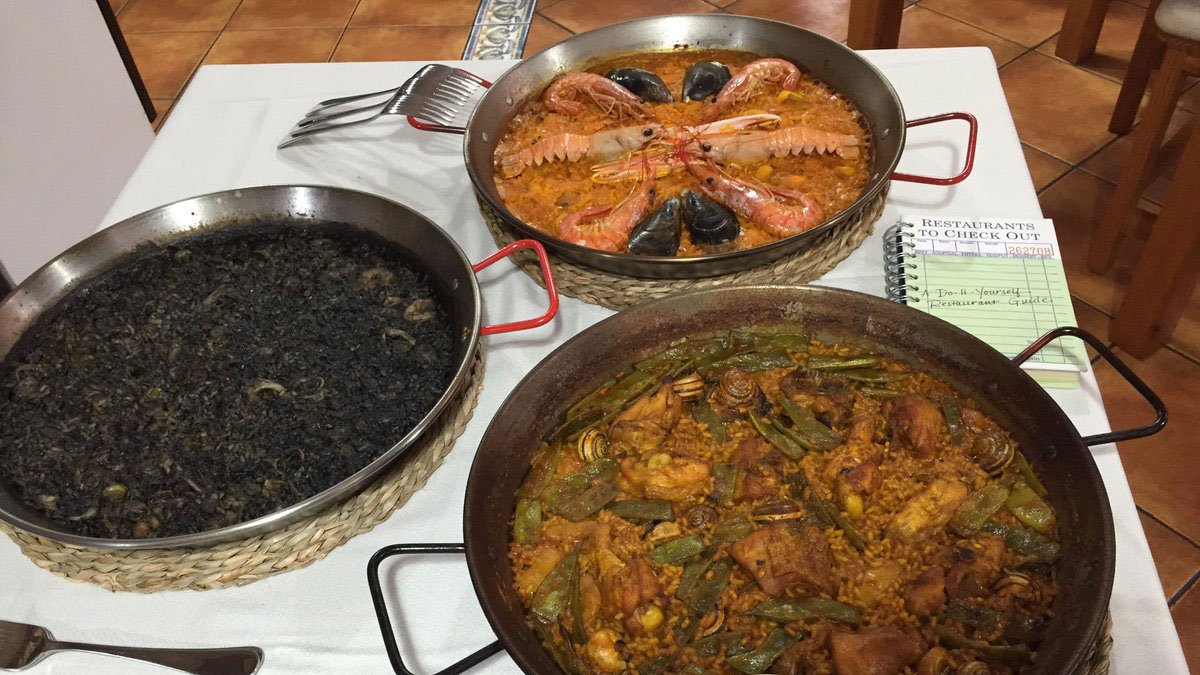
The importance of being Paella

First of all we must say that "paella" is the name of the pan recipient (in Valenciano language/dialect), very similar to "padella" that means pan in Italian. In Spanish the word for pan is "sartén". However, if we refer to the round and flap one to make a paella, we would say "paella" or "paellera" (paellera is rather used out of the Valencia community, because in Valencia it would be referred to the woman who makes paella).
Most of people in Spain make a paella that it's not the Valenciana one. The tradition on the way of making the paella depends on the different mediterranean regions and what grandparents would make according to what the land and sea had to offer.

In my experience, the paella would have green and/or red peppers (and other vegs), no green beans as in Valencia; with only chicken, with chicken and seafood, or only with seafood (clams, prams, scampi, squid, mussels). A true paella must be done outdoors on wood fire; that way and with family or folks would be the ideal conditions.
We must say that the most important thing in a paella is rice. The vegs and chicken/seafood must be present accompanying the rice and not the contrary.
Surely someone from Valencia might say that only the Valenciana one can be called paella :) But the rest of Spain eat paella too!
Actually,
in every town, in every family, the paella is made in a specific way, with its personal touch.

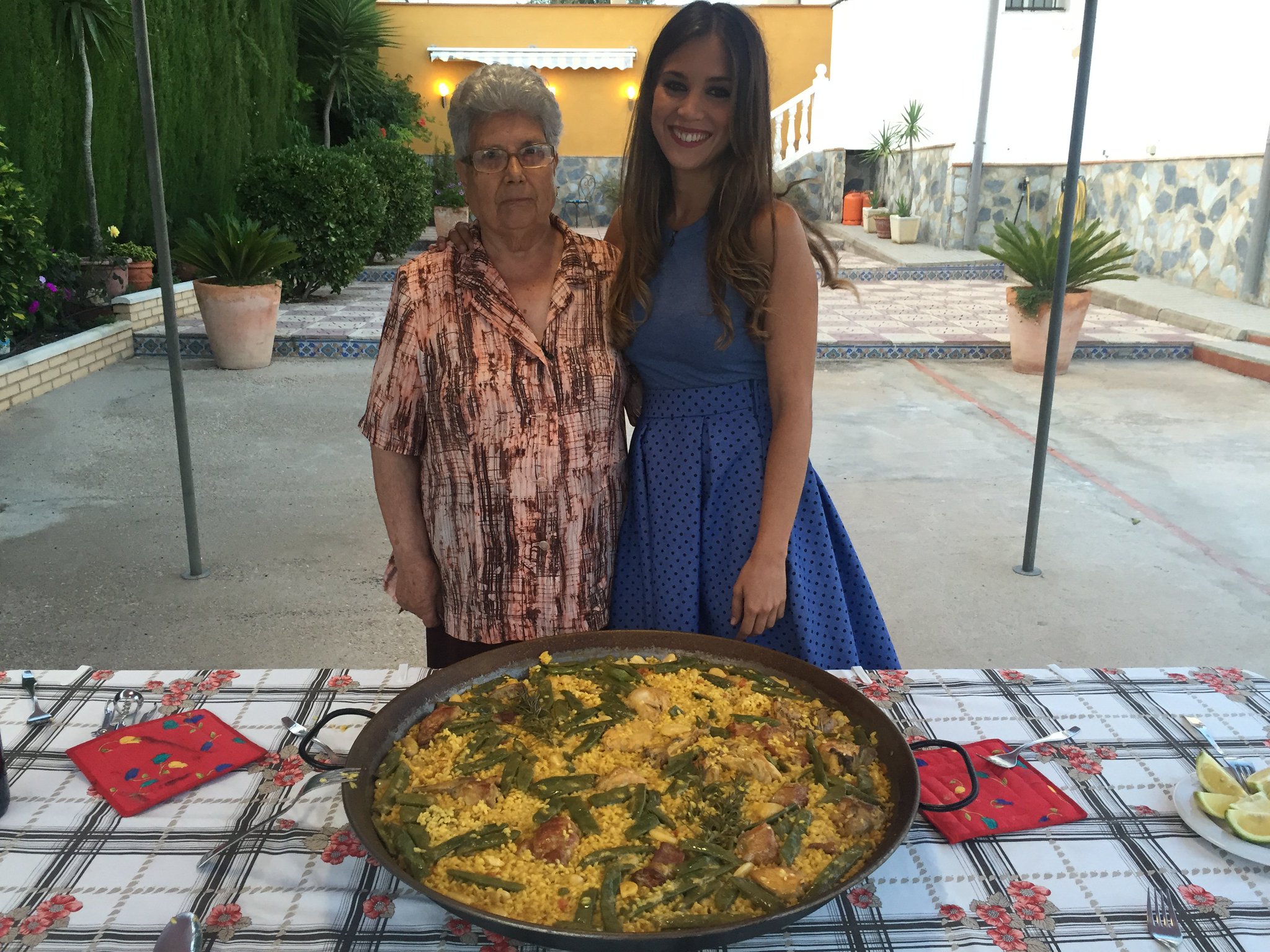
PAELLA VALENCIANA


Ingredients it may have: garrofón (a big white bean that can only be found in the zone of Valencia), flat green bean, chicken, rabbit, tomato,
artichoke, saffron. It's optional adding snails. Some add also sweet papikra and/or garlic.
//www.abc.es/viajar/restaurantes/20140722/abci-wikipaella-recetas-201407211914.html


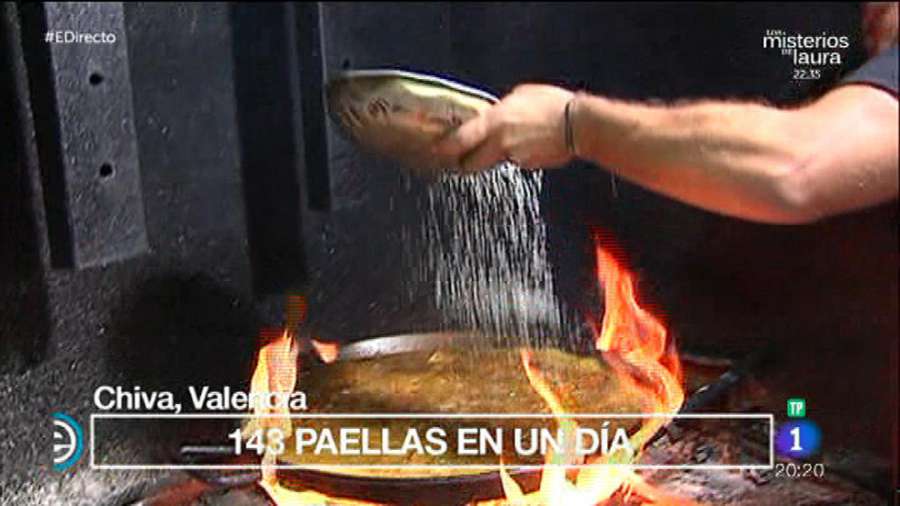
Video 1:
Chiva (Valencia) - Watch video, via España Directo
Video 2:
Chiva (Valencia) - Watch video, via Aquí la Tierra

OTHER PAELLAS


Ingredients it may have: chicken, seafood; green/red pepper, tomato, garlic (some prefer with onion),
artichoke, peas, saffron, sweet papikra.


Video 1:
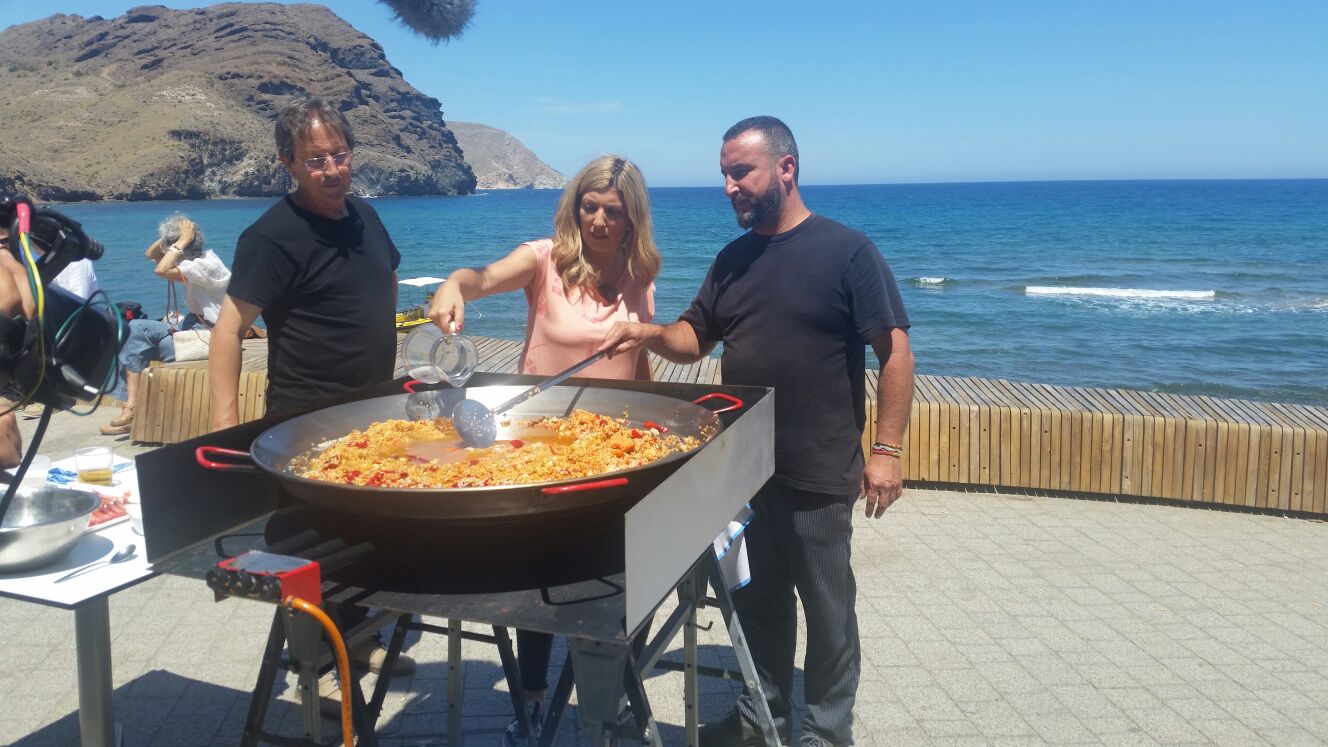
Las Negras (Almería) - Watch video, via Aquí la Tierra
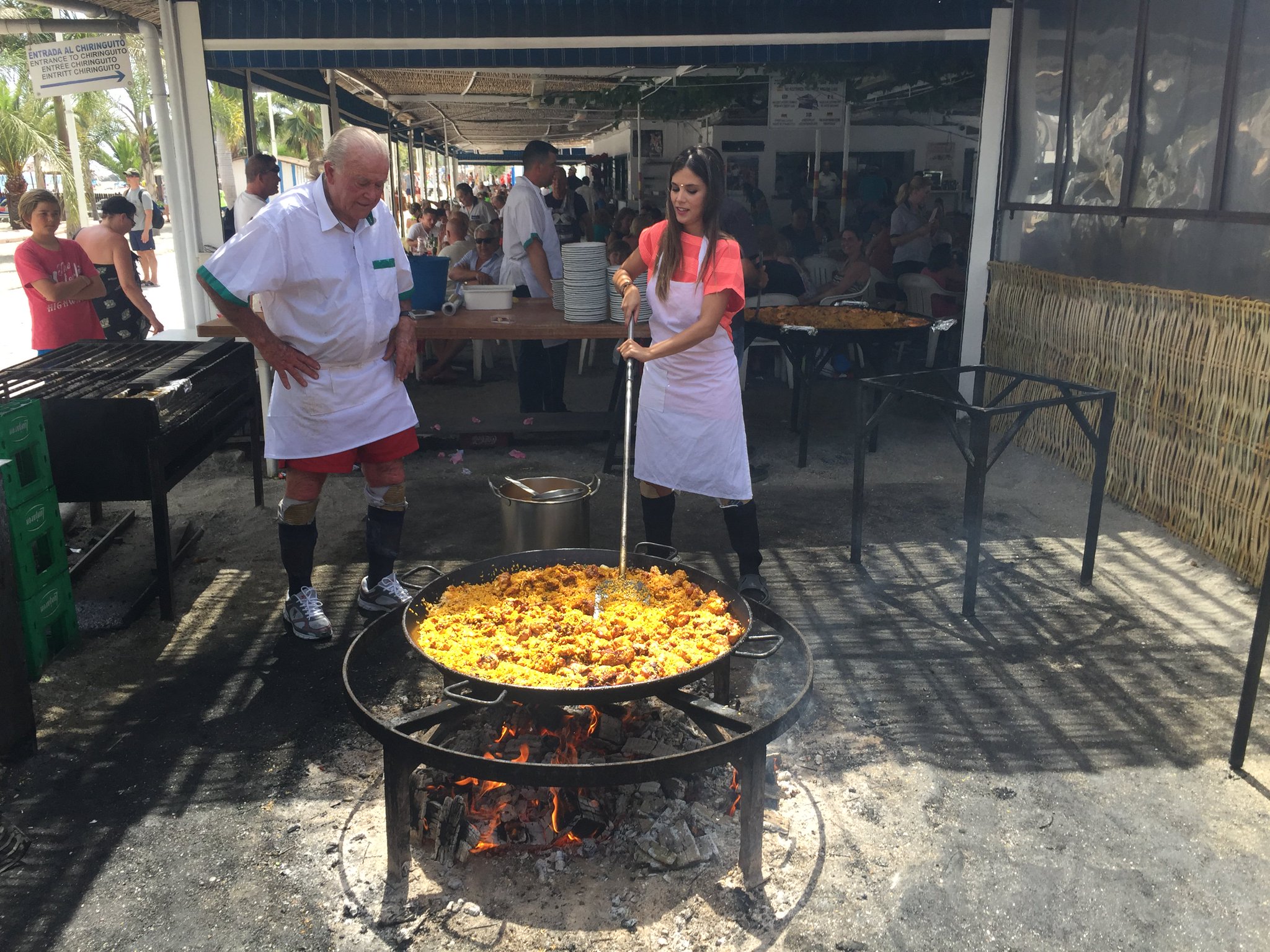
Video 2: Nerja (Málaga) - Watch video, via Aquí la Tierra
Video 3: Calasparra (Murcia) - Watch video, via España Directo

Note:

- The ingredients of Almería video are cuttlefish, red peppers, onion, red prawn, tomato, sweet paprika.
- The Nerja video takes place at the same beach and restaurant that appears in an episode of tv series Verano Azul (1981). The owner of the restaurant (in the video) appears also in that episode of the series.
- The Calasparra video shows several types of paella.


Other pictures:

- Paellas made on wood fire, via twitter
- Paella with seafood, via twitter
- Paella Valenciana made indoor (blog with pictures), via twitter

Monday, October 5, 2015

Wonders of music reveals heaven in the visit of Pope Francis to US

Music discovering during PopeinDC

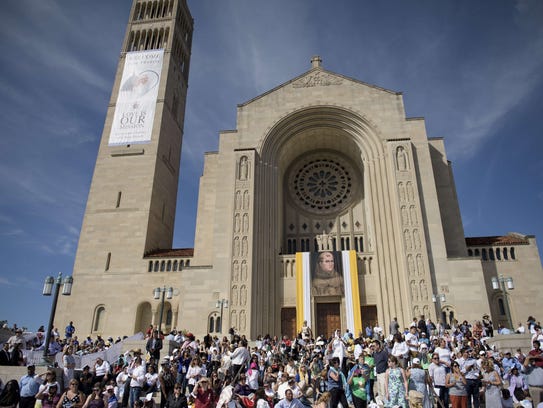
During Pope's Francis visit to Washington, I discovered some music composed for Junípero Serra's Canonization Mass at the Basilica of the National Shrine of the Immaculate Conception on Sept. 23, 2015, in Washington. Thankfully, the event was
broadcast live on tv... #PopeinDC.


Before Junípero Serra's Mass. PopeinDC. Source: usatoday


The music that called my attention is the one of the Psalm 96, that was composed especially for the Mass by Tony Alonso, who at only 35 is considered one of the most prominent American composers of liturgical music... as praytellblog reports... "My father is from Cuba, to be composing something for the first Latin American pope — who, ironically, will be visiting Cuba before he makes his first visit to the United States, where he will be celebrating a mass in Spanish — touches me on an especially personal level... No pope has celebrated mass before in the U.S. in Spanish".


Junípero Serra's Mass. PopeinDC. Source:
video

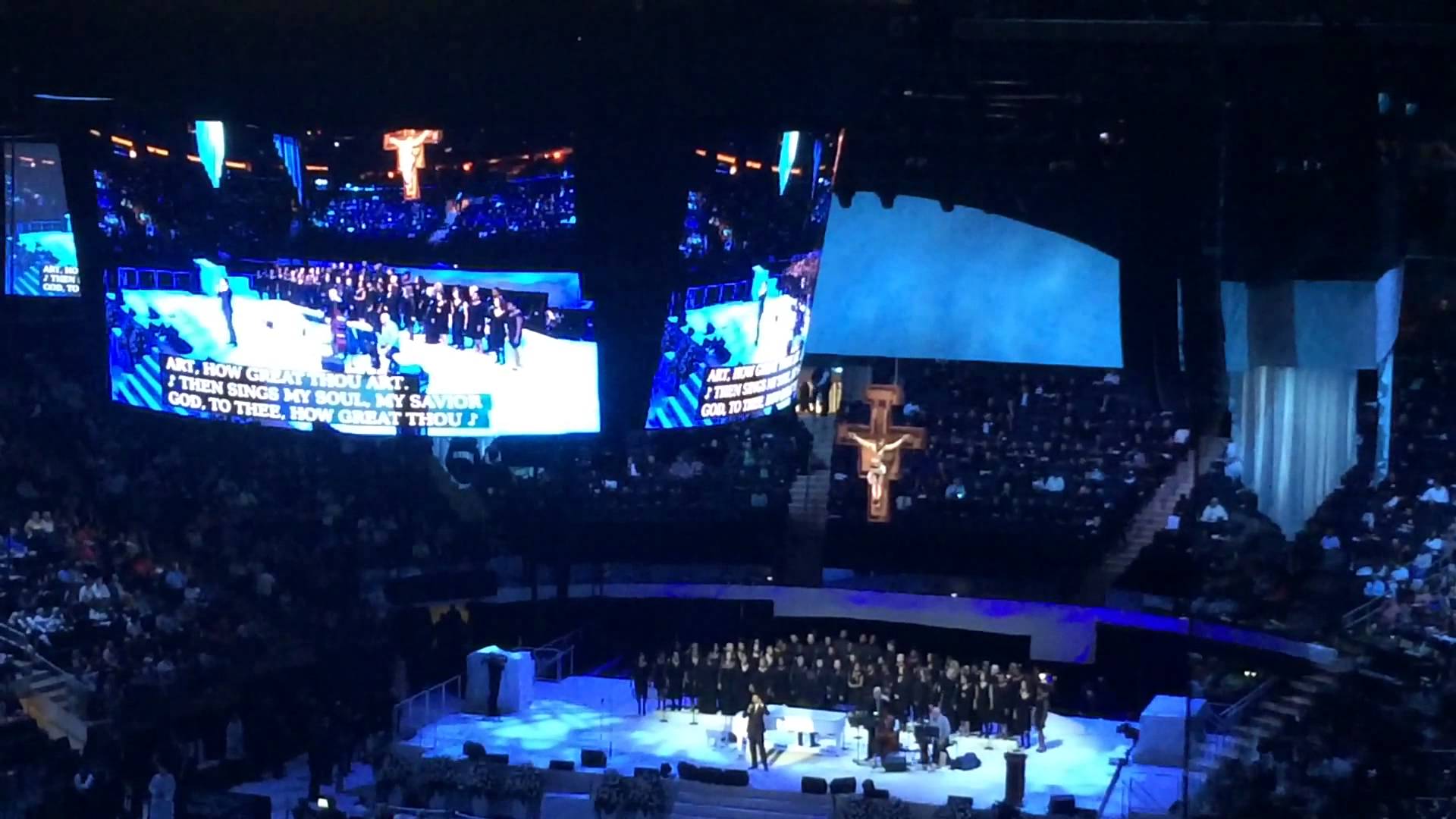
Five groups performed, including a gospel choir, the Catholic University Chamber Choir and a “Papal Mass Choir” of 90 participants selected from more than 300 people who auditioned in the D.C. area (washingtonpost). The choral leading voice was carried out by a smiling wonderful opera singer, Colleen Daly, another amazing discovering.


Orquestra and choirs. Mass PopeinDC.
Source: video

Actually, I fell in love with the wonderful music for the Psalm 96. This music has a trombone beginning reminding of some jazz song... all the music is like a wonderful film soundtrack whose notes of joy get to elevate the spirit, waking it up to the most musical soul.


Opera singer Collen Daly. Mass PopeinDC.
Source: video

Note: Psalm 96 seems to correspond to Salmo 95 in Spanish. Mass program and lyrics sources: popeindc.cua and usccb

Watch and listen Psalm 96 music: VIDEO

Responsorial Psalm 96 - Lyrics

Cuenten las maravillas del Señor a todas naciones,
Proclaim his marvelous deeds to all the nations,
Cuenten las maravillas.


Canten al Señor un cántico nuevo,
Canten al Señor, toda la tierra;
Canten al Señor, bendigan su nombre.

Chorus

Proclaim his salvation day by day,
tell among the nations his glory,
and his wonders among all the peoples.

Chorus

Familias de los pueblos, aclamen al Señor,
aclamen la gloria y el poder del Señor,
aclamen la gloria del nombre del Señor.

Chorus

Worship the Lord in holy splendor.
O tremble before him all the earth.
Say to the nations, “The Lord is King.”
He will judge the peoples in fairness.

Chorus

Some music during PopeinNYC

United Nations:
Another wonderful performance, during Pope Francis's visit to US, was the one at the end of his speech in the UN. A chorus of men and women wearing typical world dresses sang a popular Argentinian lullaby (romereports), "Duerme negrito" (Sleep little black boy), with an impeccable southern America black sound.
Pope Francis' full visit with speech to the United Nations: VIDEO (hopefully, the song should be at the end of the video. Not checked)


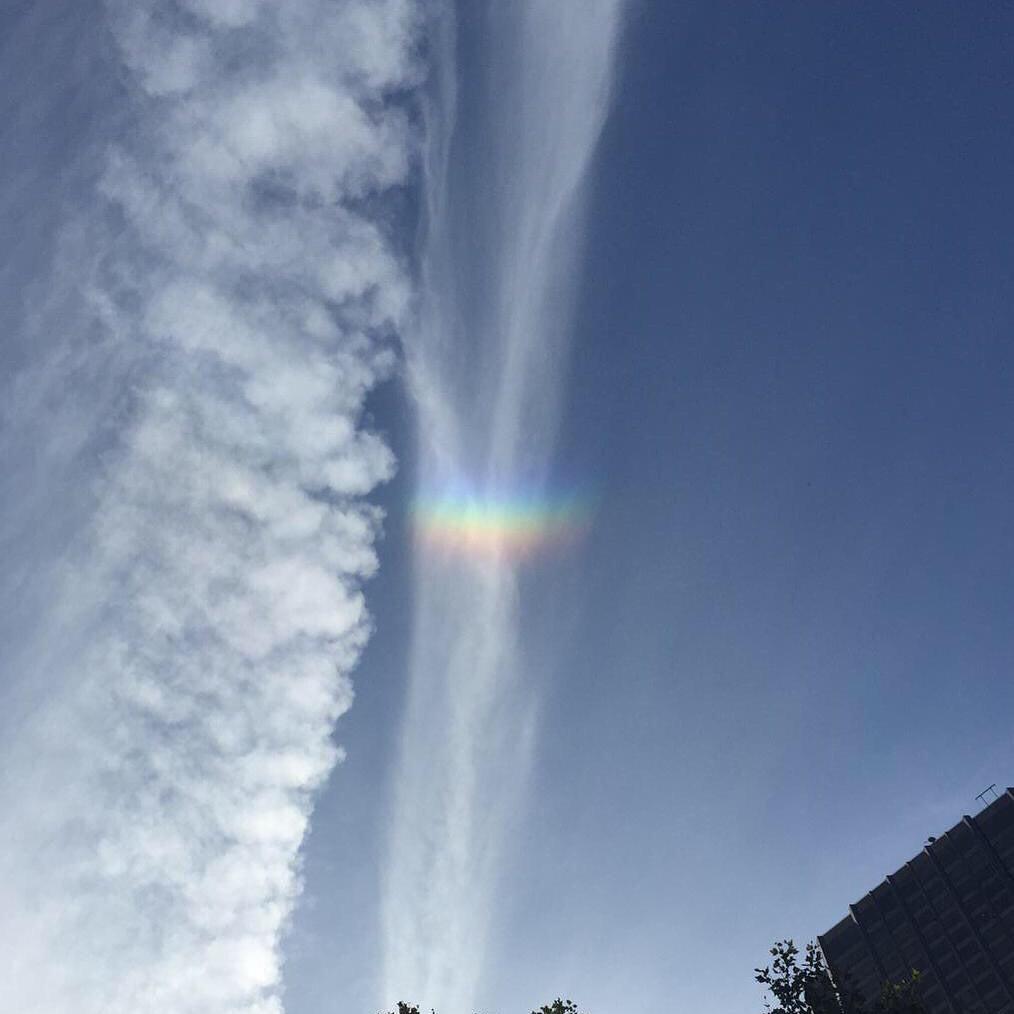
Rainbow angel... j
ust before arrival of PopeinMSG, NYC via twitter

Madison Square Garden: During the Papal Mass in the MSG in NYC there were also musical performances... Full Mass: VIDEO (not checked)
Picture: Harry Connick Jr singing at MSG before the Papal Mass in NYC pic via twitter

Saturday, June 6, 2015

How to speed up or slow down a video clip on VirtualDub

A. The full video
Example: if video fps (frame rate per second) is 30, and we wanna speed it up 5 times
Click frame rate: check "change fps to:"150.0000 and Convert to fps: 30.0000
1. Video: select "Direct stream copy"
2. Audio:
a) Select "Full processing mode" and check "Use advanced filtering" -> select "Filters": add this filter chain input -> stretch -> output
Select Stretch and click configure: ratio will be 0.5 if you want to double the speed or 2.0 if you want to halve the speed.
b) Select appropriate Audio Compression.
  Save as avi (video will not be re-encoded, audio will be)

B. A part of the video:
Example: You want the middle of the video in slow motion.
First check the video FPS and audio sample rate in the file information (example: 25fps and 44100, 128 stereo)

1. Select the first part (normal speed) and click:
Video: "Direct Stream Copy"
Audio: "Full Compression" and choose original compression (44100,128 stereo).
Save video (first part)

2. Set the new start point for the second (slow motion part) and the end point.
Video: "Direct stream Copy"
Frame rate: Change Frame Rate to FPS: 12.5;  choose "Convert to FPS" and insert 25.
Audio: click compression again and save the new clip. If you want the audio slowed down ->select "Use Advanced Filtering" -> Filters: make chain (Input' 'Stretch' 'Ratty Pitch' and 'Output')
Click on Stretch: rate=2
Click on Ratty: 2
Compress the audio
Save the new AVI

3. Select the third part:
 reset the video frame rate and turn off the advanced filter.
Video direct stream copy
Audio: recompress
Save video (third part)

4. Reopen VirtualDub.
Open part and append the rest (easy if you name them 1, 2, 3)
Direct stream video and audio.
Save the new file.

More info: link1, link2

Sunday, August 3, 2014

A happy summer

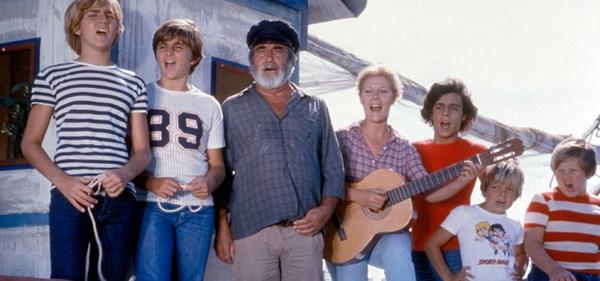
Verano Azul (Blue Summer) is a beautiful example of how happy kids can be when they play freely in nature in a healthy way during the summer holiday.

Singing "No nos moverán" on sailor ship. Source: @tve_tve

The idol (El ídolo) - Episode 15
I enjoyed very much this episode. It's about a singer, fans, fame and being oneself.
Watching this old tv series again is such a happiness... And this episode is all great. I'd love it had subs in English... It's about a super popular singer that comes with TV to the village to film some videos surrounded by fans. The two girls of the friends group are very excited, as one has even the poster hang on her room wall. The boys feel just curious and also excited TV is coming. The singer looks unhappy and fed up of all those "hired" fans, his manager just think of business. Sailor man doesn't know him as doesn't have any TV or radio set. During the filming of a video, the singer falls in the sea, but can't swim and the boys rescue him. "Journalist" of singer team publishes a fake story saying that the singer rescued one of the boys.

Two musical moments... Soy como tú (video), Te doy (video).
That same singer participated, with his true name, on a popular music festival (video)
Watch episode on rtve

Shall we not be moved (No nos moverán) - Episode 17
A real estate wanna build lots of flats towers at the coast village. The sailor man doesn't wanna sell his ship-house, despite he's been offered a large amount of money. The village shop men accuse him of egoist, because he's not accepting a "social" use of property. The unscrupulous "brick" men try to bully him by putting wires around the ship and, later, by taking machines to his property, despite a welcome ban of building high buildings. The sailor man doesn't wanna use gun violence as his barman friend suggests. The group of friends defend the ship with music. 

This episode shows us how with just a guitar and a song we can build for Peace. The first time I listened the song "No nos moverán" was thanks to this tv series. Just a few years ago I knew it was a popular song by Joan Baez (video).

Moments singing "No nos moverán": video (with sailor man on ship), video (when the machines start destroying the tomato plants around the ship). The girls of the group don't appear on the songs.
Watch episode on rtve

Other episodes I like
- The meeting (El encuentro) - Episode 1. Watch on rtve
- Do not kill my planet please (No matéis mi planeta por favor)- Episode 2.  Watch on rtve. Beach pollution.
- Pancho Panza - Episode 3.  Watch on rtve. Sancho Panza: Don Quixote's faithful adventures pal. Paella.
- Beatriz mon amour - Episode 7.  Watch on rtve. Funny scene in a summer cinema with Doris Day's song.
- The cave of the green cat (La cueva del gato verde) - Episode 10.  Watch on rtve. Trip to find a cave of a green cat, they actually discover another one. Not missing kite thread...
- The bottles (las botellas) - Episode 11.  Watch on rtve. Mysterious bottles appear with love messages at the beach. The importance of forgiveness and reconcile.


Monday, June 30, 2014

The fairy who built houses for the gnomes

The first time I heard the name Ana Maria Matute was when, being just a kid at school, I had to read a book titled Paulina. I remember myself not receiving that school task with much joy, as I thought it was not  probably like the books by foreign authors I was used to read from my little library at home: Books with tales by Grimm Brothers, Perrault, Andersen... Those little women, Heidi, Don Quixote comic version for children... Bugs Bunny's, A Disney comic book... and a few more.
The truth is I can't remember the story of that book, however her name kept in my memory... and one day I had the opportunity to know that amazingly she was a writer who loved the stories of fairies, elves, and gnomes; this happened some years ago when watching a great tv program about literature where, with other great writers, she had a talk with children about the magical world of fairies, gnomes, fantasy, tales, and the classics of literature for "all ages" children. Watch video
That was my first encounter with the writer. Another special moment was when she was awarded with the Prize CervantesSpeech (Español).
Though my encounters, so far, with her books have just been merely anecdotal, I can say that listening on the radio any interview or talk about her magical world actually causes fascination.
In a world where technology, phones and computers seem to be dominating the human mind, life and our closest relationship with the world, where children are having less and less space for imagination and fantasy, it makes you feel hopeful and grateful that a fairy has left such a wonderful legacy on her books, where now we can meet her and her magical world every time we wish.
This is a fantastic recent article in English about her: "Cervantes winner Matute: A child's view of Spain's Civil War"
I also came across with a wonderful interview on La Vanguardia, that I've translated into English, because I thought it was worth sharing with the whole world.
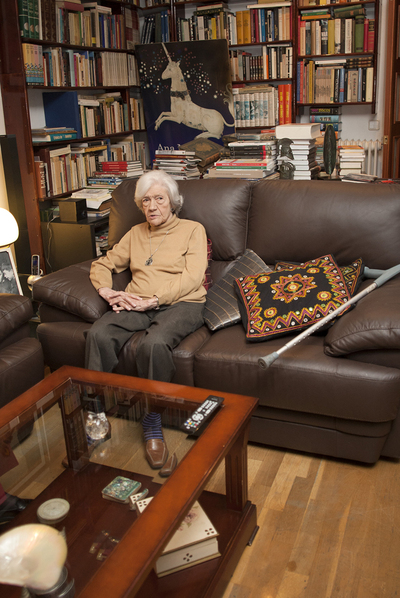
Picture: With her doll house for gnomes; Picture: With kids at a school

Ana María Matute: "Todo está cargado de magia" "Everything is full of magic"
Translation from article: 19 April 2013, La Vanguardia Magazine

In Ana Maria Matute's flat in Barcelona, there is a house under construction. It is a building of three floors of those with which children play, and it is half done next to the window, along with some scattered pieces. Across the living-room, on a table, there is a miniature reproduction of her work studio, a sacred place that no one can enter, "but it's like this, so you can figure it out perfectly," she says. The writer, probably the most important in the world of Spanish language, speaks at 87 with energy, whispers, waves her crutch, laughs with girl eyes ... The excuse of the meeting is the new edition of their children's tales that undertakes the publishing "Destino".  

A few days after meeting her, the Magazine escorted her to public school Palma de Mallorca in Barcelona's Nou Barris district, where students had read The green grasshopper and were longing to meet her. "I like dealing with kids, it's one of the things I miss most. I love it because they have no bad respect me, they speak to me informally quickly". Matute makes them laugh out loud, rebukes them, talks to them about issues such as depression, is interested in their home countries ... brandishes its lightweight crutch, not the one given to her by King Juan Carlos and she keeps in her apartment: "It is very nice with lights, cushions and all. I saw it to him when the Cervantes prize, 'we both wear crutches', I said to him, but yours is spectacular, 'and he sent it home to me. But I only wear it for special occasions because it is heavy and uncomfortable to wear".


At her home in Barcelona. Source: El Pais

Do you have children at home? 
No. Why ...?

Because the Dollhouse ...
I'm building it myself. It has still enough to build left... But it's not for dolls, it's for gnomes. But now they are not in.

How?
They will come once the house is finished, not before. They come, they always come. I have built them many houses, even in the forest, on the trees, even once in a forest in Sweden.

Now published again all your children's stories, one by one. Who did you write them for?
For my son. For children. I feel rage when they try they are considered texts for adults ... There are things in them that adults do not understand, these texts are only well understood by the little ones. Being a child is hard. Everything is against you. And you see things that others do not see, and no one appreciates you. But before they were even less valued, they were like pets, the Brothers Grimm did not write their stories for them, they are full of terrifying and horrible things, but better that way, because nothing must be hidden from children, they must not be treated as disabled, they understand the world better than anyone.

But they are stories that like also to adults
Yes, of course. To adults who know how to look at. Julio Cortázar told me, in fact, what he liked the most by me were the children's stories. But he had a privileged perception, he was a magician, you know? He came to meet me at Sitges because he had loved my novel "First memory" (Primera memoria) (1959). I am very old and I've known them all: Pablo Neruda gave me a hug in Moscow at a writers' conference and, holding me, he took me to several places, I remember I got so excited that my husband thought I was not going to wash my coat anymore.

You have two registers, the realistic and the fantastic. The arid Artámila stories and the magic of "Forgotten King Gudu" (Olvidado rey Gudú), so to speak.
There was a time when writing something unrealistic was very complicated. Still, there's always something magical on a text of mine. But what is reality? To me, a gnome is a tremendous realism. I have built them many houses.

Your father manufactured umbrella, right?
And my grandfather. It still exists the property, with the sign Matute at the door, it was also a metals store. It's owned by my cousins, my brothers did not want to keep on it.

When do you write?
In the morning, but not early. Sometimes I tell my children: "Do not call me for lunch".

And now?
I'm trying to make a new novel called Family Demons, but the dizziness will not let me, let's see if they can remove them from me, it's very heavy/disturbing, a new trouble, the machine is getting old.

But age looks good for a writer ...
Yes, you are more objective, you have more experience, and also you manage it better ... It's useful to you in order to sneak out of certain things. And you know your limits more.

But what limits do you have ... to write, I mean?
None. I do not put barriers to me. But while it's phenomenal to reach an age like mine, on the other hand is very sad because everything dies: you see in the paper how your friends get dropping , everything that was your world crumbles and appears as a field of ashes.

Your world are also those who read her now, right?
Sure, it's not that I'm completely knackered.

What is your first memory of life?
Me in someone's arms cradling me, I do not know if male or female, I'm very cuddled, and there is a lamp on the table, and a song is playing like a soft humming. My mother would say to me, "You can't remember that, you were months old" but I described her the lamp and I was right.

You have always kept the eyes of a girl, at least as a writer.
Yes, and as a person too, and that's why I have had many disappointments.

But, maybe, thanks to those disappointments, you have been able to write as you do.
It not only teaches the bad, but also the good. I am innocent, yes, I keep some from the young because every day I have a disappointment or a surprise , and that's not old people's.

What do you do when you get up?
Fortuny's crossword on La Vanguardia. In addition, I have become her friend and he shows me many times in the definitions.

Your first marriage, held in 1952, was unsuccessful ...
He took our child away from me in 1963, when we separated. In the whole world custody is granted to the mother, but here, with Franco, it's not. I was nearly three years separated from my son. Fortunately I had a very good mother in law, who allowed me to see him behind his father. The child is this gentleman who has opened the door to you, what do you think?

It was a time when nobody spoke of abuse, either physical or psychological. Neither anyone got separated.
But I did. I do not know where I got the strength from, I've never been loud-mouthed or bossy, I have always tried to go unnoticed. After three years I was already sick of my husband, but we were married for over ten years. Until I left.

How were your parents ?
They were right wing; my father, manufacturer, and my mother, daughter of landowners from La Rioja. I would write my novels, I wrote since I was five, but my mother made me knit before, until she realized that I was different because she was not dumb at all, she never went to bed without reading. My father had a small library and he often took us to the theater in Madrid, mostly. The other day I went to see the work in which Vicky Peña plays Maria Moliner.

Miller wanted to become language academic, as you are.
It was logical I became, but academics did not want... like Caballero Bonald, who has been very late to become. We are lifelong friends. When I was married to the bad one, he abandoned me in Mallorca without money. He went to Madrid "to fix it all" actually to mess around and to discuss at cafes, was his specialty. He left me hanging in a hotel. Camilo José Cela knew about it and showed up there with his wife. Charo, paid 6,000 pesetas that we owed from the bill and she took me to their house, where I was living for three months. And there Cela had Caballero Bonald as his secretary, we were both like two kittens picked up from the street. I was like her daughter, so I have always seen Cela as someone fatherly.

And then both, Caballero and you have been Cervantes prize ...
But then what we liked to read was "Pulgarcito" (Little Thumb. A Spanish comic), that Cela's son received and that we would take away from him at every opportunity. "What a pair of intellectuals we are!", we said each other among laughter. Above all, we loved "La familia Cebolleta" vignettes (Falmily Spring Onion. A Spanish comic). When the parents invited the boss home to dinner, to impress him they wore a cape and clothes that, when he arrived, made him exclaim: "Oh, what an Asian luxury!". We kept that phrase, and it's the one we sent each other by telegram when we both won the Cervantes. We have taken many gin and tonics ...

Now you must not take so many ...
The doctor says I'm doing well, although my son suspects falsely that I fall down in hotels because of the drink, but no, it is because of the mats they put under the beds, in which my crutch get hooked. The doctor told me that those mats have killed more people than Hitler and Stalin together.

You lived in a men's world. You were the only woman with all the major literary awards: Nadal, Planeta, the Critics, the National ...
Always. It took me a lot to have friends like Josefina Aldecoa, Carmen Martín Gaite and Ana María Moix, who wrote me a letter when she was 17. She told me she would wear a leopard skin, and I replied: "Well, I one of widower cat", and she believed it! One day, she invited me to see Cleopatra with Terenci (Moix) at the cinema. Now I don't watch so many movies because I've gone deaf. But yes, in the literary circles there were men, and I came and drank with them. They called me "the little Cossack", because I followed their pace. I have drunk a lifetime, with my little brother ... sometimes we would get drunk. Women of that time were, as I called them, re-embarrased ladies, they only thought about making a good wedding.

Do you think you could win the Nobel one day? 
Never. He already died in the 90s, the Swedish scholar who defended me, Artur Lundkvist.

You were discovered by the editor Ignacio Agustí .
I went to be discovered. When I was 17 I had written a novel on a graph notebook, Pequeño teatro (Little theater). One day I asked, "What is the best publisher in Spain?". "Destino", I was told. And there I went to. They did not receive me, and finally a guy told me, "I'll let you come in." Agustí was a whole gentleman, he treated me very politely and told me: "You must edit it with the typewriter" I did it, and I sent it to him; and it had not even been a week since that I met him on the street. "Miss Matute, we have read your book, but how old are you?". I was 19, and he replied, surprised: "We are going to publish your book, come one day with your father." We signed a 5,000 pesetas contract for life. My father said, "Don't you could give her a little more?". And Josep Verges, the owner, said: "It's a product that we don't know how it will be doing." Sure, an editorial is not a non-profit, but at that time the contracts were unconscionable.


Didn't you have then in behind an agent like Carmen Balcells?
She played a decisive role in that my back to write. Without her, Olvidado rey Gudú (Forgotten King Gudu) wouldn't have existed, which is the book I would choose from among all mine. I had been 18 years without writing, do you realize? Because of a very bad depression. Balcells asked me: "Don't you have anything?". "No, I only kept a half finished book" "Bring it to me." When she read it, she told me it had to get finished and she kidnapped me, she took me to live to her house until I finished, I got a great suite with bedroom and a work room with my electric typewriter, and a secretary downstairs who edited on the computer. I finished it in months. Finally, we had champagne and I was crowned with the crown of the King cake. Since then she represents me and everything has changed for the better.

Because writing is not an easy job ...
May nobody write to make money, because all we have dedicated to this we can explain things ...

How did Jose Manuel Lara, the founder of Planeta?
When I was nobody, nobody knew him. It was in a summer in the early 50, in Cafe Gijón, I saw a sweaty man, with no tie, he was there looking for writers among the tables, he approached them directly, he introduced himself, and he took some of them with him.

What was your happiest stage?
One of the most was when I lived with my second husband in a duplex in Sitges. We had three terraces and two fireplaces. We lived in swimsuit, if not naked. I wrote all day. I have traveled very much, my husband had a second home in Hong Kong and we went there every year. I've known all the world ... except Oceania.

And your experience in the United States in the sixties? 
It was extraordinary. I was living in Indiana, Oklahoma and Virginia. I had just get my son back. First, I was invited by an American professor, who said: "Of all the Spanish authors I read, the one I've liked the most is you." And I and Jose Aldecoa were invited, a week each. Then they chose me to teach for a year. All Spanish Republican exiles were in US, I met everyone. The one I remember the most is Francisco Ayala, who I fondly called "the devil." Students of those years still come to meet me, of my lessons of Contemporary Spanish Novel, in which I even included Maria Aurelia Capmany. At returning, my son didn't like Spanish girls, they looked really timid.

And if you were in Sitges, did you know the writer and journalist César González-Ruano?
No. That one was best known by my first husband. All that mob did awful things, they took money away from each other. My ex did not bring money home, it only entered what I got.

You never saw him again?
Yes, when he was already very ill in a nursing home. I went to see him and then I regretted it, because he began to talk bad about me to my son. He could not help it: he was mouthed and bad.

You precisely have known to reflect the wickedness of man in your works.
Yes, and mostly stupidity. Evil and goodness are very exquisite, but they have few representatives because they are the product of high intelligence. But stupidity is lavished ...

Happy childhood is talked, but yours ...
I had only happy moments. And other very bad. When a child misbehaved, a punishment was to put it in a dark room, without thinking about the traumas it could create. My brothers came out crying. I misbehaved so that they put me inside, so that they leave me alone.

What pleasure did you find?
It was wonderful. What I called the light of the darkness. There I began to be a writer, to see reality from another way. I called it the city of the closets, which did not reach the ceiling. I opened the drawers, touched the screens. One day, I picked up a lump of sugar, I split it in two and a blue little light came out, that semms to be a thing that happens, as when you put fresh fish in the dark, and I got marveled: "I'm a magician!" I believed it. And I still keep on believing it.

You never talk about politics.
I have been a Communist ... until I went to the Soviet Union, six months in Russia were enough for me to see what it was that. Today, it drives me mad the cuts and evictions, I do not understand how they are able to leave people in the street.

If I had to recommend just a book ...
The Bible. I read it as a child and then I have read then several: Protestant, Catholic ... it is the best adventure book that has ever been done. Olvidado rey Gudú (Forgotten King Gudu) and all my books come from the Bible. Then, Don Quixote, I was made to read it as a teen and I found it horrible, I got bored, I didn't understand anything, but, at 18, everything already changed. It is the first book which I've cried with, with Don Quixote's death, for all what it means: to let the madness go away. That is terrible. The triumph of good sense.

That has not happened to you yet?
It would be very hard for me.

You have fame of sponsoring female writers ...
Of that critics are to blame, who do nothing but see feminine features, or mine, in the books girls write. It makes me mad. They confused Carmen Martín Gaite with me, when we are day and night. "Primera memoria" (First memory) has nothing to do with "Entre visillos" (Between curtains).

Have you got on with the critics?
I haven't cared what they said. I have not had bad reviews either, but something worse: misunderstanding, to see how they talk and talk about a book of mine during pages without having understood. That sinks you. Theory is what from literature I have left. My classes consisted in reading books and explain them, very vividly, I approached what the writer had done.

What are you reading lately?
Henning Mankell, detective novel, the last three of Enrique Vila-Matas ...

Who told you stories?
My nanny, we were like their grandchildren and she told us stories of elves. Nanny Anastasia from Burgos. She explained to us that, in the small villages, in the fall, at night, when it started to be cold, the elves could not get under the trees, they were cold and hungry, and she put bowls of grain in the door so that those beings ate something, and a little cider so that they get warm.

You were a stuttering girl, right?
Yes, but it suddenly disappeared with the bombings of Barcelona. That anguish: you didn't know what to do, if you moved, you could be killed, but if you kept still, too.

How long have you gone to mass?
Until 16 or 17 years. I left it soon, but now ...

Have you changed?
I am a believer now. For ten or eleven years, maybe more. I don't practise because I can't walk. And because I was once at a church that it's nearby ... and there was no one! I said to myself, "What am I doing here?". I got up and went. I have an idea of God, one day I felt Him in a very profound way.

Does it help you to write?
Yes, I feel better believing.

What else do you believe in?
I believe in many things that have nothing to do with most people's beliefs ... Do you believe in coincidence? Well it does not exist; it only seems, but everything has a reason, nothing happens without a reason. Living, speaking, is magic. Everything is full of magic, magic makes we are here chatting. If not, we should be nuzzling in the mountains.

"El que no inventa, no vive" "Who does not invent, does not live" - Ana Maria Matute

Wednesday, May 1, 2013

Work is one of the most beautiful gifts that God has given to us

Nature.-
   These ones are some of the words of Pope Francis said during the Mass of today, May 1st, day of work, Saint Joseph the worker's day. 
"The most beautiful gift that God has given to man: the ability to create, to work, to be the makers of our own dignity.
"Work gives us dignity! Those who work have dignity, a special dignity, a personal dignity: men and women who work are dignified. Instead, those who do not work do not have this dignity. But there are many who want to work and cannot."
"Not paying a just wage, not providing work, focusing exclusively on the balance books, on financial statements, only looking at making personal profit. That goes against God!"
 "We can no longer say what St. Paul said: - He who will not work, will not eat -, but we have to say: He who does not work, has lost his dignity, because he cannot find any opportunities for work"
"This is what happens now! People are less important than the things that give profit to those who have political, social, economic power"
"Today, it would do us good to listen to the voice of God, when he spoke to Cain, saying: "Cain, where is your brother?". Today, however, we hear this voice: "Where is your brother who has no work? Where is your brother who is subjected to slave labor?. Let us pray, let us pray for all these brothers and sisters who are in this situation. So be it".
   These ones are some of il Papa Francesco's tweets for today: 
"Dear young friends, learn from Saint Joseph. He went through difficult times, but he always trusted, and he knew how to overcome adversity"- Pope Francis
"How marvellous it would be if, at the end of the day, each of us could say: today I have performed an act of charity towards others!"- Pope Francis
* More info:
http://www.news.va/en/news/pope-dignity-for-the-dhaka-workers-dignity-for-the  
http://www.twitter/pontifex

Sunday, April 28, 2013

Save the Bees! - ¡Salvemos las abejas!


    Surely you will have heard that bees are disappearing and nobody knew why. Recent studies have confirmed that the cause are all the poisons used in agriculture. Pesticides can be lethal for bees, and in low doses they can cause a lot of disorders as the loss of memory. This makes us think that pesticides could be also the cause of Alzheimer disease in humans, the same way they are one of the causes of Parkinson Syndrome.
    Why are bees so important? Bees are responsible for the pollinating of plants, flowers, and vegetables. Without bees we won't have the sweet healthy honey, and we won't have fruit and vegetables to eat. Bees are in danger, agriculture is in danger, we humans are in danger. And that's not all, if the bee that survives pesticides suffers from memory loss ... it doesn't know how to return to the hive, becomes disoriented and can not go back home to make honey and wax, products so needed in our food and in our home.

What is happening to bees should be taking into account as part of a scientific essay and like a prove that pesticides can be the cause of so many unexplainable neurological diseases happening in humans. Bees in their natural environment and the use of pesticides are like a live laboratory to watch what could happen to humans.
    What can we do? It's simple. Don't use pesticides on agriculture, don't use pesticides in parks and gardens, there are healthy alternatives for it, buy and eat organic fruit and vegetables.
    The companies of pesticides have a high influence on politicians and they move a lot of money. However the battle is not lost, there is much we can do. No matter if you are a politician, no matter if you are involved in agriculture, or if you are just someone concerned with human health and the health of each and every living being in Nature. Just "Be the change you wanna see in the world". 
     Together we can Save the Bees!


Synhalonia on Phlomis 5
   
     Seguramente habréis oído que las abejas están desapareciendo y que nadie sabía por qué. Estudios recientes han confirmado que la causa son todos esos venenos utilizados en la agricultura. Los pesticidas pueden ser letales para las abejas, y en dosis bajas pueden causar muchos trastornos como la pérdida de memoria. Ésto nos hace pensar que los pesticidas podrían ser también la causa de la enfermedad de Alzheimer en los seres humanos, de la misma manera que son una de las causas del síndrome de Parkinson.
    ¿Por qué son tan importantes las abejas? Las abejas son responsables de la polinización de las plantas, flores y verduras. Sin abejas, no tendremos la tan dulce y saludable miel, y no vamos a tener frutas y verduras para comer. Las abejas están en peligro, la agricultura está en peligro, los seres humanos están en peligro. Y eso no es todo, si la abeja que sobrevive a los pesticidas y plaguicidas sufre pérdida de memoria... no sabe cómo regresar a la colmena, se desorienta y no puede volver a casa para elaborar la miel y la cera, productos tan necesarios en nuestra alimentación y en nuestro hogar.
    Lo que está pasando con las abejas debería tomarse en cuenta como parte de un ensayo científico y como prueba de que los pesticidas pueden ser la causa de muchas enfermedades neurológicas inexplicables que ocurren en los seres humanos. Las abejas en su medio natural y el uso si los pesticidas son como un laboratorio vivo para ver lo que podría pasar a los humanos.
    ¿Qué podemos hacer? Es muy sencillo. No utilizar pesticidas en la agricultura, no utilizar pesticidas en los parques y jardines, hay alternativas saludables para ello, comprar y comer frutas y verduras ecológicas.
    Las empresas de pesticidas tienen una gran influencia sobre los políticos y  mueven mucho dinero. Sin embargo, la batalla no está perdida, se puede hacer mucho. No importa si eres político, no importa si estás involucrado en la agricultura, o si eres sólo una persona preocupada por la salud humana y la salud de todos y cada uno de los seres vivos de la naturaleza. Simplemente "Sé el cambio que quieres ver en el mundo".
    ¡Juntos podemos Salvar las Abejas!

* More info / Más info :
http://www.greenpeace.org/international/en/news/Blogs/makingwaves/european-agriculture-at-risk-time-to-ban-bee-/blog/44656/
http://www.greenpeace.org/espana/es/Trabajamos-en/Transgenicos/Abejas/


Friday, June 8, 2012

Celebrate what you have


   The tv spot of this Summer in Spain is "Celebra lo que tienes" (Celebrate what you have) by Mahou, a beer trademark. This spot has called my attention so much and I'm so excited about it that I've decided to translate it for you.

   "Now... now... no? Now we are downhill you come to conquer us. Let me tell you one thing: You don't know us! We, with very little, get ourselves up, because here everybody, absolutely everybody has a song... and every time it sounds, I don't know how, but... troubles disappear, that is magic! And we have friends who are not friends, they are brothers! And what you tell me about our football (soccer) team? Los Tocaínos (invented name)... We will never win the League, but I feel so proud of them when I see them dressed in shorts every Sunday. Besides, we have grandparents... do you know what is talking to them?... about whatever! And we have our home, the first bath of the summer, "flesh and bone" (real ones, you can touch) friends and facebook ones. We get excited with anything... to score a gol!... we have to cry of joy, to be wrong and be forgiven... the meetings at home, the favors... we have our Saturday Mahou (a beer mark)... So, you'd better go back the way you have come! (People cheers)"

   After talking about this spot in twitter, I looked at the sky and I had the most magical experince ever... Some day I will talk about it :)


Thursday, March 29, 2012

The Influence of Electromagnetic Waves on Health and Nature

   How electromagnetic waves affect health in relation to geographical factors: 
Houses located in granite areas accumulate large amounts of radon gas, which is carcinogenic, and the incidence of lung cancer is high in those areas. Radon gas can exist in any area, although most abundant in the granite, so it is essential to ventilate houses.
On the other hand, the place where the house is can influence our mood. We could talk about the existence of 3 kinds of places: relaxing, euphoric and depressive. We must avoid spending much time in the most negative of the house, avoid "Hartmann crossings." How can we know where there is a crossing of Hartmann? One way is to use dowsing rods (they are metal and L-shaped), hold them without moving and walk around the room, at the moment there is a crossing Halmark (because the muscles of our arms will have contracted slightly) will produce a closer and even a cross rod, according to the intensity of electromagnetic energy concentrated in that area. If you have pets: cats often choose the most negative to our health as her favorite place, however dogs often choose the most positive. It is important also the orientation of the bed should be north to south. It has been found that most of the animals are guided instinctively N to S to sleep. Many phenomena considered "paranormal" are a consequence of the concentration of electromagnetic waves which produce resonance in an object or being which contains the same wavelength. An example would be: we have a violin and play a string sound that has a specific wavelength, the waves travel across the room and placed the violin in the other corner of the room will also sound or resonate because, having a string of the same wavelength we play with his hand, made wavelength resonance (In physics this phenomenon is known as Electromagnetic Resonacia, which is nothing in the physical principle underlying the Nuclear Electromagnetic Resonacia Imaging diagnosis is used both in medicine) 
   Electromagnetic waves are harmful to health? There is much contorversia about it. The reality is that there are studies that say so. What happens is that they have as much publicity as the estuidios to the contrary. The economic interests of large telecommunications and technology companies are so big they could expliacar why advertising is ma studies that say they are not harmful. One study saw how subjecting mice to mobile phone waves for 3 hours a day were changed to 150 brain proteins. When you alter a protein also alters the function for this protein. This means that electromagnetic radiation could alter brain processes. Another study looked at how the neurons were destroyed contained in a petri dish after receiving waves from a mobile phone for 3 minutes. How might this happen? Very simple. It was thought that cells communicate chemically (by neurotransmitters), and electrically, but now we have seen that also communicate electromagnetically. 
Electromagnetic waves inhibit melatonin, a hormone naturally synthesized at night when we sleep. This hormone has an important antioxidant that prevents cell damage.
 
   Devices that emit electromagnetic radiation (from 800 Mhz up is when it starts to be harmful to the organism): computers, mobile phones, DECT wireless phones, telecommunications antennas, microwave ovens, wireless keyboards and mouse ... The closer your body is the device much worse, it is recommended to put the device far from our body and use handsfree or headset. 

   Nature is ill: It is said that since WiFi networks are everywhere in our cities we are causing many problems to Nature: It is believed that could cause the disappearance of bees, withering fall flocks of birds, the disease of many trees turning yellow. And all for the phenomenon of resonance, if the water or blood or any substance that is part of a bird is a wave of the same resonance wavelength would and could be causing it to fall to the ground without explanation. 

   How can we protect ourselves? 

Avoid using wireless devices that operate by radio frequency.
Use external keyboard and cord mouse to the computer. 
Use wired Internet connection, avoid WiFi, 3G ...
Use your mobile phone as little as possible and in any case, away from the head and the body (headphones or hands free)
At home, avoid using DECT cordless phones, which are worse than the signal emitted by mobile phones, DECT emit during 24 hours, excepting the ECO models (they work like the mobile phones emitting only when you call or receive call and in stand-by from time to time) 
There are chances of isolating the house to radiation, but I imagine that it must be a major investment. Don't live near electrical transformers. 

What better can help is by taking antioxidants found in fruits and organic vegetables
Others recommend a salt lamp.
Others have cactus near the computer ... (It is not clear that protect today given the high intensity waves have surrounding us) 
We also recommend turning off the power grid during sleep, there are some devices that connect to the light box to facilitate connection and disconnection is operated as a light switch)
Place the bed N to S, avoid TV and computer in the bedroom, and unplug the other devices at bedtime. 
Ideally, a geobiological study in the house before buying it, or when there are health problems.


Sunday, February 26, 2012

How to set File Extensions Association on VLC Portable

    This tip is for Windows:

   After having tried to do it through VLC preferences, and manually in Folder Options with no success, I got it worked by doing this...

Step 1: Go to Start --> Settings --> Folder Options --> File Types
 There select and click remove the file extension you wish VLC opens as default player, for example: AVI.Now you'll see the icon of the AVI files has any specific.

Step 2: Right-click on an avi file --> "Open with", choose VLC or browse looking for the folder where vlc.exe is and select. Now all AVI files will open with VLC.

* This is a tip that worked fine for me, any change you make on your computer is your responsability. Steps can vary according to the Windows version


Wednesday, February 22, 2012

How to fix Flash Player 9 for Internet Explorer

Adobe Flash Player icon

   I tried to install Flash Player Version 11 over Flash 9 and I got error about something related to Active. So, I installed again Flash Player 9, but Flash Player didn't work, the installation was not correct. Then, I realized that when installing an application you can always upgrade but you cannot "downgrade" without having uninstalled the app. What did I do to fix it?

   Things you should do before anything:

1. Keep a copy of the plugins of Flash Player you have in your browsers: Flash9f.ocx (optional) (in IE, C:\WINDOWS\SYSTEM\MACROMED\FLASH ), NPSWF32.dll (in other browsers. It can be found in the plugins folder of the browser app or in C:\WINDOWS\SYSTEM\MACROMED\FLASH). Anyway, you can find easily the plugin making a search in C:\ windows
    In order to view the plugins don't forget to check view all files: On the windows 98 main bar: view --> folders options --> view files --> Show all files

2. You should have the installation file of Flash Player 9 or the version compatible with your OS. As we are trying to fix the plugin for Internet Explorer, it must be the Active X version: "Install Flash Player 9 AX"
    * In order to view the plugins don't forget to check view all files: On the windows 98 main bar: view --> folders options --> view files --> Show all files

   STEPS TO INSTALL FLASH PLAYER 9 AX FOR IE:

1. Execute the Flash Player unistallation tool You could find it in C:\WINDOWS\SYSTEM\MACROMED\FLASH.
2. Delete the windows registry keys of Flah Player. You have to be very careful doing this, and remember that if you modify anything in the registry it's your responsability. Here I'm just explaining the steps that worked fine for me.
   Search "Regedit" in C:\WINDOWS and open it. Now click HKEY_LOCAL_MACHINE, then click Software, here click Macromedia: now right-click on Flash Player (keys for browsers which are not IE) or Flash Player Active (key for IE) and choose delete. Now you will have deleted the register keys Flash Player plugins for all the browsers in the computer, how I myself did, or only for IE, depending on what you deleted.
  3. And now we can install Flash Player AX. The files, probably, will be installed inside: C:\WINDOWS\SYSTEM\MACROMED\FLASH 

   Now just open Internet Explorer and check a YouTube video for example. If you can see the video Flash Player has been installed correctly!

   Is it all? Noooo! You must check that Flash Player in all your other browsers are working well too! If not... Just place manually a copy of NPSWF32.dll inside the Plugins folder of every browser. If you don't have this plugin in your computer you can find it in internet: search

   This is just a personal experience that I share in case it can be useful for anyone.

  * Location of files and plugins can vary according to your version of Windows (Use Windows "Search" to locate them).


Wednesday, October 26, 2011

The Jesus of San Francesco d'Assisi

   San Damiano cross is an icon dated from 1100, by unknown author and byzantine style.
   This is the cross San Francesco d'Assisi (St. Francis of Assisi) was praying at the San Damiano church when having his big encounter with Jesus, and Christ replied to him  "Go rebuild my church which is falling down." .

   In 1257 the followers of Saint Clare of Assisi, the Poor Clares, left San Damiano and took the Cross with them to the new Basilica of Santa Chiara. They kept it for seven centuries out of the public. Since 1957, the original cross hangs in the Basilica of Saint Clare (Basilica di Santa Chiara) in Assisi and everybody can watch it. A copy of the original cross hangs in the original position inside the Church of San Damiano, Franciscans cherish this cross as the symbol of their mission from God.

   The story of San Francesco and the Cross: One day, the Lord promised him he would give answers to his questions very soon. Later on, while walking the Assisi streets, he went into the church of San Damiano, knelt down to pray, and suddenly the Jesus on the cross spoke to him and said: "Go rebuild my church which is falling down." Francesco thought God wanted him to physically rebuild the collapsing church building, so he started making repairs on the church and other church buildings. But over time, Francis realized God wanted him to rebuild the entire Church around the world, through prayer, poverty, and peace.
Francesco began to preach through the narrow streets of Assisi, saying "Pace e Bene!" meaning, "Peace and goodness to you!" 

   San Francesco was the Nature Lover, he gave love to animals, preached to the birds, and built the first Nativity crib.

   This is San Francesco's prayer before the San Damiano Cross:

Altissimo glorioso Dio,
illumina le tenebre de lo core mio
et da me fede dricta,
sperança certa
e caritade perfecta,
senno et cognoscemento, Signore,
che faça
lo tuo santo e verace commandamento
  Amen

Most high, glorious God,
enlighten the darkness of my heart
and give me a correct faith,
a certain hope,
a perfect charity,
sense and knowledge, Lord
so that I may carry out
Your holy and true command
Amen

Assisi panorama

   Last week I received a wonderful gift, and unique experience. I knew the cross of San Francesco had come to my city, to the convent of the Clarisas (Poor Clares). I couldn't miss that unique opportunity and went to see the cross. A vigil was taking place. When we arrived to the church the cross was not still there, so we went out to the right side, where the convent is. Something unexpected happened, a small group of people carrying the Cross singing and playing guitar came toward us. The impression of Jesus on that cross coming to me was such, that emotion was stronger than me and I began to cry. I don't know if it was the music, I don't know if it was just Him, but something happened to me.
   We followed the group of people and entered in the church. The vigil, accompanied by songs with the guitar, was followed by the rosary prayer and the Mass. At the beginning of the ceremony, a man spoke to tell us all the details about the Cross and its meanings. This one was a copy, smaller size than the original one, that had been brought from the Poor Clare Convent in Italy and it is travelling through several convents of the "Clarisas" in Spain. The Christ of San Damiano cross is a Christ with a serene face, no crown of thorns... He's alive and glorious. His posture expresses a gesture of welcome and seems to embrace the whole universe. The icon hides a lot of meanings and symbolism. It was all quite interesting.
   I was all the time I could staring at Jesus, and talking to him. This is the Christ of Love, I think. I've got in love with this icon. After the Vigil everybody had the chance to kiss Jesus. I touched my heart, and put my hand with a kiss over his lips.


Wednesday, October 12, 2011

America


   ¡Feliz día de la Hispanidad para toda América!, la del Norte, la del Centro y la del Sur. Con todo cariño.

   Happy day America!, North, Center and South. With much Love.

   This is a beautiful song written and composed by Jose Luis Perales, one of the best Spanish musicians.  

América

Me hueles a merengue y a bolero
a caña y a café
me hueles a corrido y a charango
carnavalito y miel
Me hueles a maracas y a guitarra

a gaucho solitario y a sabana
a piel morena y sal

Me hueles a canela y a bananas
querida siempre y siempre maltratada
soñando libertad

América, América
me hueles a guayaba
a cordillera helada
a tierra verde
y lluvia tropical
me hueles a pradera
y a eterna primavera
me hueles a futuro y libertad

Me hueles a tabaco y a manises
a dátiles y a ron
me hueles a emigrantes que se fueron
cantando una canción

Me hueles a torrente y a quebrada
a sangre campesina derramada
para tu libertad

Me hueles a mujer enamorada
querida siempre y siempre abandonada
soñando frente al mar

 - JL Perales  

América (English Translation)

You smell of a merengue (music type) and bolero (music type)
  of coffee and sugar cane
  You smell of corrido (folk mexican song) and charango (small five-stringed guitar)
  of carnavalito (folk dance in Argentina) and honey
You smell of maracas and guitar,
  of lonely gaucho (cowboy in Argentina) and savannah
 of brown skin and salt

You smell of cinnamon and bananas
forever loved and mistreated
dreaming freedom

America America
You smell of guava green
of icy mountain range
of green land
and tropical rain
You smell of meadow
and eternal spring
You smell of future and freedom

You smell of tobacco and peanuts
to dates and rum
You smell of emigrants who went away
singing a song

You smell of torrent and stream
You smell of peasant shed blood stream
for your freedom

You smell of a woman in love
forever loved and abandoned
dreaming in front of the sea

Listen Song

Monday, October 10, 2011

Love One Another - Amaos los Unos a los Otros

Love one another, as I have loved you (John 15:9-17) 

9 I have loved you just as the Father has loved me. Remain in my love.
10 If you keep my commandments you will remain in my love, just as I have kept my Father's commandments and remain in his love.
11 I have told you this so that my own joy may be in you and your joy be complete.
12 This is my commandment: love one another, as I have loved you.
13 No one can have greater love than to lay down his life for his friends.
14 You are my friends, if you do what I command you.
15 I shall no longer call you servants, because a servant does not know the master's business; I call you friends, because I have made known to you everything I have learnt from my Father.
16 You did not choose me, no, I chose you; and I commissioned you to go out and to bear fruit, fruit that will last; so that the Father will give you anything you ask him in my name.
17 My command to you is to love one another.

Amaos los unos a los otros como yo os he amado (Juan 15:9-17)

9 Como el Padre me amó, yo también os he amado a vosotros; permaneced en mi amor.
10 Si guardáis mis mandamientos, permaneceréis en mi amor, como yo he guardado los mandamientos de mi Padre, y permanezco en su amor.

11 Os he dicho esto, para que mi gozo esté en vosotros, y vuestro gozo sea colmado.
12 Este es el mandamiento mío: que os améis los unos a los otros como yo os he amado.
13 Nadie tiene mayor amor que el que da su vida por sus amigos.
14 Vosotros sois mis amigos, si hacéis lo que yo os mando.
15 No os llamo ya siervos, porque el siervo no sabe lo que hace su amo; a vosotros os he llamado amigos, porque todo lo que he oído a mi Padre os lo he dado a conocer.
16 No me habéis elegido vosotros a mí, sino que yo os he elegido a vosotros, y os he destinado para que vayáis y deis fruto, y que vuestro fruto permanezca; de modo que todo lo que pidáis al Padre en mi nombre os lo conceda.
17 Lo que os mando es que os améis los unos a los otros.